
Hello, welcome to another episode of ‘The Homefront’ by Reclaim Oneonta, where we report on Oneonta’s class divide from the tenant’s point of view.
As of May 2026, Oneonta’s local government has begun to consider adopting the Good Cause Eviction Law. You can learn more about it by watching the first episode of “The Homefront”, but in short, it’s a law that would keep landlords from evicting tenants or increasing the rent above 10% without providing a justification. Importantly, it would also block them from refusing to renew a tenant’s lease without strict justification as well. So far, the law has been discussed briefly by the city’s housing commission and common council, with more talks to come in the future. This is the result of pro-active tenants along with progressive members of the common council bringing up the law.
This is all definitely good news. This means there is a real chance to relieve tenants from the stress of excessive rent increases or unfair evictions. It’s entirely reasonable to have some amount of hope that Oneonta’s city government will act in our interest. But what happens if they don’t?
As things stand, the common council can simply choose to not pass the good cause eviction law with no fear of consequence. As the conversation around the good cause eviction law gathers momentum, landlord reaction against it will almost certainly grow as well. Just like with the 27 Market street housing initiative, they’ll try and put out propaganda every way they can to sow doubt in the legislation. If the landlords’ counter attack goes unchallenged, there is a pretty high chance they’ll succeed. They are more than capable of influencing a common council that is prone to vacillate on these issues.
Some insight can be gleaned from an article posted by the Daily star about a recent meeting titled “Oneonta committee wants more info on Good Cause Eviction.. In it, 5th ward council member Len Carson said he was (quote) “not seeing a need for it” (unquote) when speaking about the Good Cause Eviction Law. Of course, Len Carson isn’t a tenant and has never been accused of being too pro-tenant, so one has to wonder how he knows what our needs are better than we do. At the same meeting, 7th ward council member Karolyn Marks said “our rental population is completely different” from the many cities in New York that have adopted the law. (Santomauro-Stenzel & The Daily Star, Oneonta, N.Y., 2026) In reality of course, Oneonta tenants fear arbitrary evictions and ridiculous rent increases as much as any other group of tenants across the country. In fact the unique thing about Oneonta is just how difficult the situation is for tenants.
Of course, there have also been common council members who have been in favor of the Good Cause eviction Law, like the first ward’s Elayne Mosher Campoli, who wrote on facebook:
“I support Good Cause Eviction, because tenants deserve stable homes to rent and live in. Reducing unnecessary evictions helps prevent homelessness, which is a significant challenge our city is dealing with. I brought this to council’s attention last year, and again this year when rent control failed to gain traction, so I am glad to see it being studied now after a group of local tenants brought it up to the mayor for consideration. I have been a renter most of my entire adult life, so I understand and value the peace of mind this could give tenants.
I also support tenants’ right to organize and I’m proud to see this happening in our community!”
This reflects the diversity of perspectives when it comes to the interests of tenants. Many are uncertain and hesitant, a fact which landlords will likely take advantage of, while others are more supportive of our demands. As things are, which side wins is basically a toss up. Really, it’s a toss up that favors the landlords who are always willing to act for themselves to influence the course of events. While certain council members like Elayne are unlikely ever to be swayed against the good cause eviction law, the same can’t be said for all the other members of the common council. The question is whether or not the tenants of Oneonta are fine taking this gamble. Are we really fine with just letting the government say ‘no’ to our needs without putting up a fight?
The reality is, without the ability to apply pressure as tenants, we are leaving our future in the hands of a class that does not share our interests. For the landlords our city isn’t mainly a place to be lived in. Many of them don’t live here. Instead, a city is a place to extract wealth from, at the cost of tenants. The more of a free hand they have in Oneonta, the more they’ll use it to hold down and squeeze tenants. Towards that end, they will always try to get the most they can out of local government. In turn, the local government typically will bend to their will. The only way to stop them from winning is for tenants to have the independent strength to resist landlords and punish the local government, most importantly through a general rent strike.
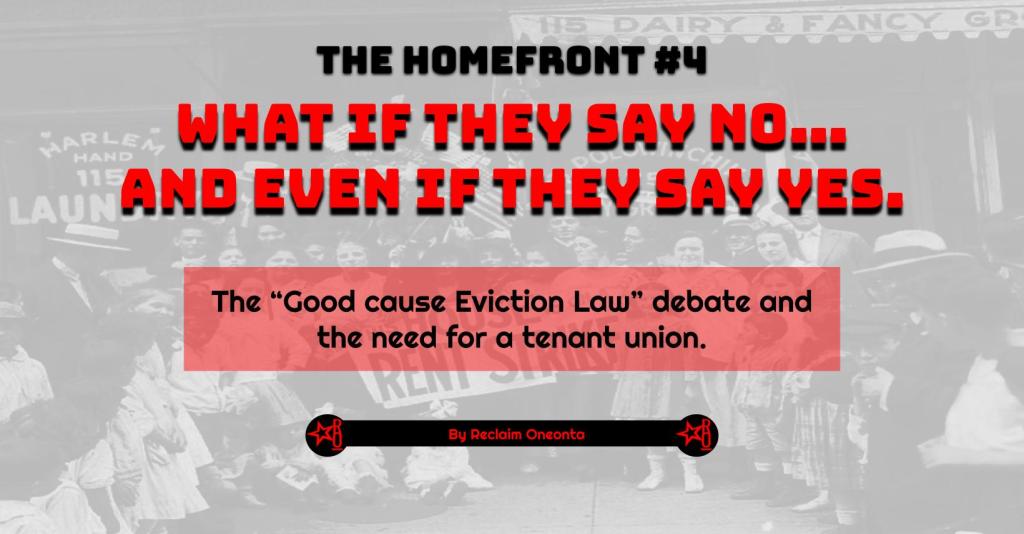
Real, lasting wins for the exploited class are never granted by the ruling class out of the kindness of their hearts. They are always the result of economic and mass action that compel the government and the ruling class to make concessions. For example, when the USA entered world war one, coal production and construction were repurposed to support the war effort. This led to a housing shortage and a lack of adequate heat for New York City tenants, while landlords continued to raise the rent. In response, New York City tenants launched a widespread rent strike starting in 1918. This strike was so powerful that by 1920, Albany was forced to pass statewide regulations which compelled landlords to supply heating during the winter months, and also placed restrictions on how much they could increase rent year over year. These were the first rent regulations in US history, and they were the product of tenant power, not government benevolence. This was possible because in New York City, organizations like the Greater New York Tenant’s League, along with other tenant unions, united tenants for common action.
This is why we say tenants have to organize into a tenant union for ourselves. Through a tenant union, we can respond if the government does not act in our interests. Instead of just throwing up our hands if the common council does not pass the good cause eviction law, we’d be able to use mass demonstrations and the rent strike to deprive the landlords and a complicit government of our money. Then, we would see how long the government would last before giving in to us. Our numbers and our money. This is the elementary power we have as a class. We simply need the organization and the will to use that power for ourselves. Those are the ingredients we will need to pressure the government into passing the Good Cause Eviction Law.
Even if the government says yes, including all of our demands without serious tenant organization prompting them to do so, it will still be our responsibility to form a union. A law is nothing without enforcement. We can’t count on the government for that either. Without a tenant union there to rapidly respond to landlords, they will find ways to undermine the good cause eviction law. Whenever tenants or workers make some progress, landlords and bosses get ready to push us back. Unions give us the strength to resist that pushback.
Every tenant needs a union, and most of us support a union. Many of us hesitate when it comes to actually building one. We have heard from tenants that, though they support the idea, their own landlord is “nice” or “good”. Maybe that’s true! In which case, they should have no problem with you forming a union with your fellow tenants and pushing for the good cause eviction law. If your nice landlord wouldn’t actually be comfortable with you forming a union, maybe they aren’t as nice as you thought. In reality, a tenant union is not just to protect us against the very worst landlords. It’s an organization for self-defense and resistance that helps us push back against the whole rent system. That system is still exploitative, whether or not your landlord is nice.
How do we go about building such a union? At a basic level, this means uniting tenants in and between different buildings and neighborhoods. For that a solid rallying point that speaks to the concerns of different tenants across Oneonta will be needed. The good cause eviction law can be exactly such a rallying point, since it is in the interest of so many tenants across the city. However, this means nothing if tenants across the city don’t even know about it. This will not happen automatically. This will require active effort by tenants to go out on the street and talk to their neighbors about the good cause eviction law, win their support for it, and convince them to take collective action to win it. We have to impress on our fellow tenants that this is something we can win on our own strength, so long as we are united and determined. This will be the starting point for organizing a tenant union.
It is for that purpose above all that we are launching our current petition initiative. In short, we want to get as many tenants as possible across Oneonta to sign a petition in support of the Good Cause eviction law. While a petition signing like this may seem small, it serves an important purpose. First, it gives us a chance to talk to other tenants and inform them directly about matters concerning them. Secondly, it’s the most basic form of collective action. By signing a petition alongside our neighbors, we can begin to see the pressure our numbers exert and enter into a common effort. This first basic form of action can be connected to further action down the line, so long as we hold onto and use the connections formed in the petition drive.
This effort would be meaningless if Reclaim Oneonta did it alone. Instead we are calling for all tenants to join the Oneonta Tenant’s Movement, or OTM, and volunteer to help us collect signatures. This is a new initiative we are starting to unite tenants across the city in one solid structure for common action. The fight for the good cause eviction law is OTM’s first act. Go to the description and you’ll find a link to join the Oneonta Tenant’s Movement where you’ll find what we’re trying to build.
See you next time on the Homefront, and hopefully at a tenant union meeting.


Leave a Reply